
Hollywood’s trade class weighs in on a different kind of reunion — while its owner faces its own merger headache
Old flames: nuptials soon for ATAS and NATAS?; new burns: Penskeopoly suit
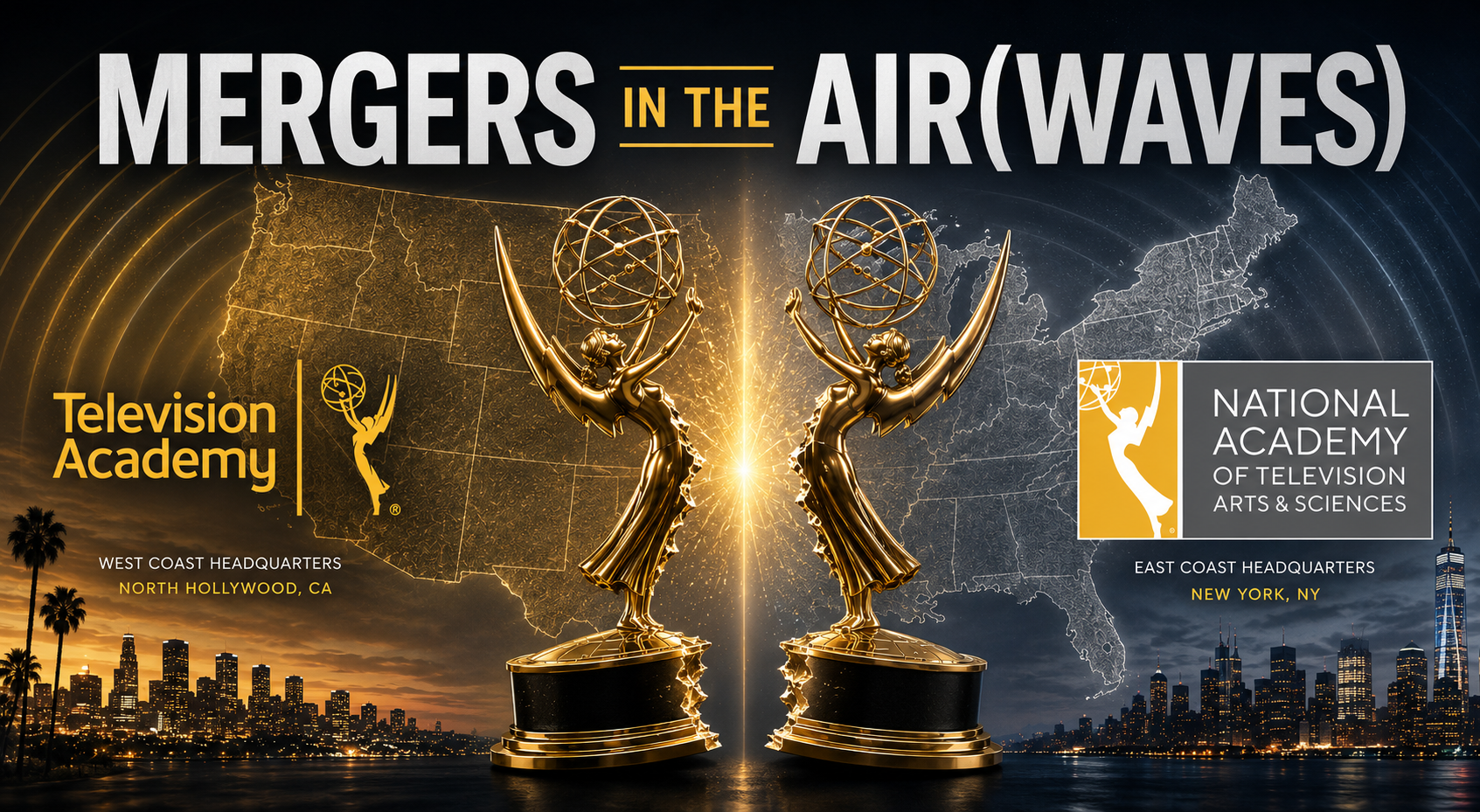
There’s a fitting symmetry to the timing. Just as Hollywood spends the week buzzing over the possibility that television’s two Emmy-giving academies might reunite after nearly five decades apart, the very company that owns most of the outlets breaking that news finds itself on the receiving end of a lawsuit that says its appetite for consolidation has gone a little too far.
A half-century divorce, possibly reversed
The headline news, as Variety reports: the Los Angeles-based Academy of Television Arts & Sciences (ATAS), aka the Television Academy, and the New York-based National Academy of Television Arts & Sciences (NATAS) have opened exploratory talks about reuniting into a single organization.
Variety notes the two academies split in 1977 after years of bi-coastal tension, forming NATAS and what eventually became the Television Academy. In a joint statement, both boards said they’d voted overwhelmingly to explore what a unified Academy could make possible, citing a stronger vision for the future and broader support for members across the country.
It’s a genuine institutional big deal. As The Hollywood Reporter lays out, the Television Academy runs the Primetime and Creative Arts Emmys, while NATAS oversees a sprawling portfolio: the Daytime Emmys, the Sports Emmys, the Children’s & Family Emmys, News & Documentary Emmys, regional Emmys, and the International Emmys. Financially, the two sides are not exactly equals — THR reports NATAS posted revenue of $9.8 million against $10.4 million in expenses in fiscal 2024, while the Television Academy pulled in over $53.5 million against $49 million in expenses, largely on the strength of the Primetime broadcast deal.
There’s no timeline attached to the talks yet, and as Deadline notes, this isn’t the first thaw between the two sides — Deadline points out that cooperation has been building gradually since 2004, when the International Academy moved to the Television Academy and the Los Angeles Chapter shifted to NATAS as part of a deal that ended prior litigation, followed by shared jurisdiction moves on the Children’s & Family and game show categories in the years since.
Not everyone thinks a merger is a slam dunk logistically, though most agree it’d be good for the medium. Gold Derby’s coverage flags that any reunification talks will have to grapple with real cultural differences between the two academies — including ATAS’s historical instinct to limit award categories to protect the Emmy’s prestige, versus NATAS’s 19 regional chapters, which collectively hand out considerably more statuettes. Over at IndieWire, an opinion column makes the case that most casual viewers don’t even realize there are two separate TV academies to begin with, and that treating Daytime and Primetime programming as equally worthy of a unified spotlight could be a genuine lifeline for an art form under pressure from streaming disruption.
Mergers: always in season
Of course, mergers are something of a house specialty around here lately — funny how often that keeps coming up in the trades, Penske Media’s trades very much included. Which brings us to a less celebratory reunion story making its own noise in the industry this week.
The HFPA comes back swinging
As Page Six and others report, the Hollywood Foreign Press Association — the organization that founded and, for decades, ran the Golden Globes before its 2023 sale — has filed a $150 million lawsuit against Penske Media Corporation, PMC chief Jay Penske, the Golden Globe Foundation, and Foundation CEO Gregory Goeckner. TheWrap’s account of the complaint says it accuses Penske and Eldridge Industries chairman Todd Boehly of orchestrating what the suit calls a clandestine scheme to fraudulently acquire the Globes and exert monopolistic control over Hollywood’s trades, awards, and advertising markets.
The specifics, per the Associated Press wire story, are pointed: the complaint alleges Penske and Boehly capitalized on the 2021 diversity backlash against the HFPA to fuel a boycott that devalued the Globes, then moved to acquire the org while allegedly deceiving its members about the terms of the sale. The AP also notes the suit claims the nonprofit Golden Globe Foundation, ostensibly independent, effectively functions as an extension of the for-profit Globes LLC entity Penske and Boehly established. The suit seeks at least $150 million, treble damages under antitrust law, and asks the court to unwind the transaction entirely.
The scope of the alleged monopoly, as a PR Newswire release from the HFPA’s legal team lays out, is worth sitting with: it claims Penske now owns or controls stakes in roughly half a dozen major awards shows — including the Golden Globes, the Billboard Music Awards, the American Music Awards, the Streamy Awards, and the ACM Awards — alongside most of the trade publications that sell the ad packages promoting awards contenders, the site that aggregates predictions for those same races, and the data firm that measures eligibility statistics for them.
Penske Media, for its part, isn’t having it. Per TheWrap, a spokesperson for the Globes dismissed the suit as recycled noise from a dissolved organization, telling reporters the transaction closed more than three years ago with all required approvals, and any claim it remains reversible is false, adding that the HFPA’s history of ethical controversy makes it an odd messenger for this particular complaint.
The awkward part
As The Playlist was quick to note, there’s an inherent irony baked into who’s covering this story. Penske Media’s stable includes Variety, The Hollywood Reporter, Deadline, Rolling Stone, Billboard and IndieWire — which makes an antitrust suit alleging media monopolization a genuinely strange thing for those same outlets to report on. The Playlist flagged that in the immediate aftermath of the filing, only The Hollywood Reporter had run a story, while Variety, Deadline, and IndieWire had yet to publish — a gap that, fairly or not, tends to reinforce exactly the argument the HFPA is making in court.
It’s the kind of self-referential moment that would make for a great trade headline — if only there were more independent trades (ahem, TheWrap, Ankler, etc.) left to write about it with enough reasonable scrutiny.